Double-entry bookkeeping in a spreadsheet, done properly
Double-entry bookkeeping records every transaction twice: once as a debit to one account and once as a credit to another, so the two sides always match. That single rule, that debits must equal credits on every transaction, is what makes a set of books internally checkable rather than just a list of numbers someone typed in.
The basic mechanics
Every account in a chart of accounts is either a debit-normal account (assets, expenses) or a credit-normal account (liabilities, equity, income). Recording a transaction means choosing which accounts it touches and posting equal and opposite amounts: a debit to one, a credit to another, for the same amount. Across the whole set of books, total debits always equal total credits, and that equality is what lets you produce a trial balance, and from it a balance sheet and profit and loss, with confidence that nothing has gone missing or been double-counted.
A worked example: recording a cash sale
Say your company makes a $500 cash sale. Two accounts are affected:
| Account | Debit | Credit |
|---|---|---|
| Bank | 500 | |
| Sales | 500 |
You debit Bank because an asset (cash in the bank) increased. You credit Sales because income increased. The two lines are equal and opposite, so the entry balances. Now say a customer later returns part of that sale for a $100 refund paid from the bank:
| Account | Debit | Credit |
|---|---|---|
| Sales | 100 | |
| Bank | 100 |
Sales is debited to reduce income, Bank is credited because cash left the account. Every transaction, however complex, decomposes into lines like these; a supplier invoice debits an expense and credits a liability (Accounts Payable), paying it later debits that liability and credits Bank, and so on. The chart of accounts just needs enough categories to describe what actually happened.
Why debits must equal credits
The equality is not a formality, it is the entire error-detection mechanism. If every entry you have ever posted balances, then the sum of all debit-normal account balances must equal the sum of all credit-normal account balances, which is exactly what a trial balance checks. If a trial balance does not balance, something was posted wrong, and you can find it, because the imbalance itself is evidence of a specific kind of mistake: a one-sided entry, a transposed digit copied only to one side, or a line left out.
Where this goes wrong in a bare spreadsheet
Nothing in an ordinary spreadsheet enforces any of this. You can type a debit into one cell and simply never get around to the matching credit, or type the wrong amount on one side, and the sheet will not object; it has no concept of an account being debit-normal or credit-normal, and no rule that stops you saving an unbalanced entry. The imbalance sits there quietly until a report built on top of it looks wrong, by which point tracing it back to the one bad line among hundreds can take longer than the bookkeeping itself.
Closing the gap
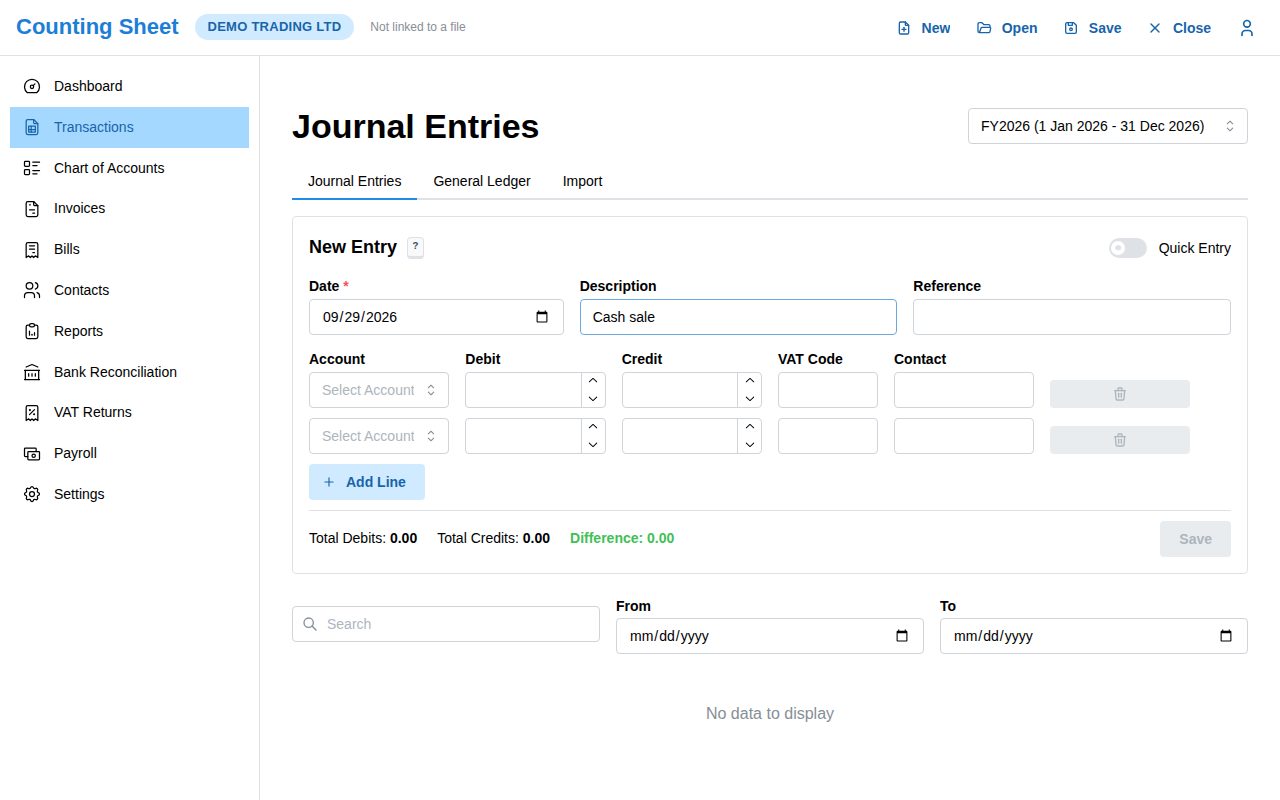
This is the specific gap a validated bookkeeping tool closes: keep the transparency of a real spreadsheet file, but refuse to save an entry where debits and credits do not match, the way Counting Sheet does on every journal entry across its full chart of accounts, invoices, bills and bank reconciliation. The mechanics above work identically whether you are entering them by hand in a blank grid or through a tool that checks your work; the only difference is whether a mistake gets caught at the moment you make it, or found months later in a report someone else is relying on.
Frequently asked questions
Why does a debit increase some accounts and decrease others?
It depends on the account's normal balance. Debits increase debit-normal accounts (assets, expenses) and decrease credit-normal accounts (liabilities, equity, income), and credits do the reverse.
What is a trial balance actually checking?
It sums every account's balance and confirms total debits equal total credits across the whole ledger; an imbalance means at least one posted entry was not a genuine matched debit and credit.
Can I do proper double-entry bookkeeping in a plain spreadsheet?
You can follow the mechanics by hand, but nothing in a bare spreadsheet stops you from saving an unbalanced entry, which is the specific risk a validated tool like Counting Sheet removes.