What happens to your books if your accounting software shuts down
Every SaaS accounting tool asks you to trust that it will still exist, and still let you get your data out cleanly, for as long as you need your books. That is a reasonable bet most of the time, but it is still a bet, and it is worth thinking through honestly rather than assuming it away.
The general problem
Cloud accounting software, whatever the vendor, typically stores your financial data in a database it operates. You reach that data through the vendor's app, and if you ever need to leave, through whatever export feature the vendor has chosen to build and maintain. That export path is usually adequate for simple cases, a CSV of transactions, a PDF of a report, but it is rarely a full, faithful copy of everything the app actually holds: custom fields, audit history, attachment links and the exact relationships between records often do not survive the trip. If a vendor is acquired, pivots its product, or shuts down, the timeline for getting your data out is set by them, not you, and it can be short.
None of this is a criticism of any specific product. It is simply what it means to keep the record of your company's finances inside a database only one company can query. The dependency is structural, not a sign that a given vendor is badly run.
Why this matters more than it seems to, day to day
Most of the time, vendor continuity is invisible, so it is easy to discount the risk until the moment it actually surfaces, usually years into using a product, with years of history now sitting behind that vendor's export tool. By then, switching costs are real: re-entering historical journals, reconciling a fresh chart of accounts, and hoping the new system's import format matches closely enough that nothing gets silently dropped.
The Counting Sheet answer
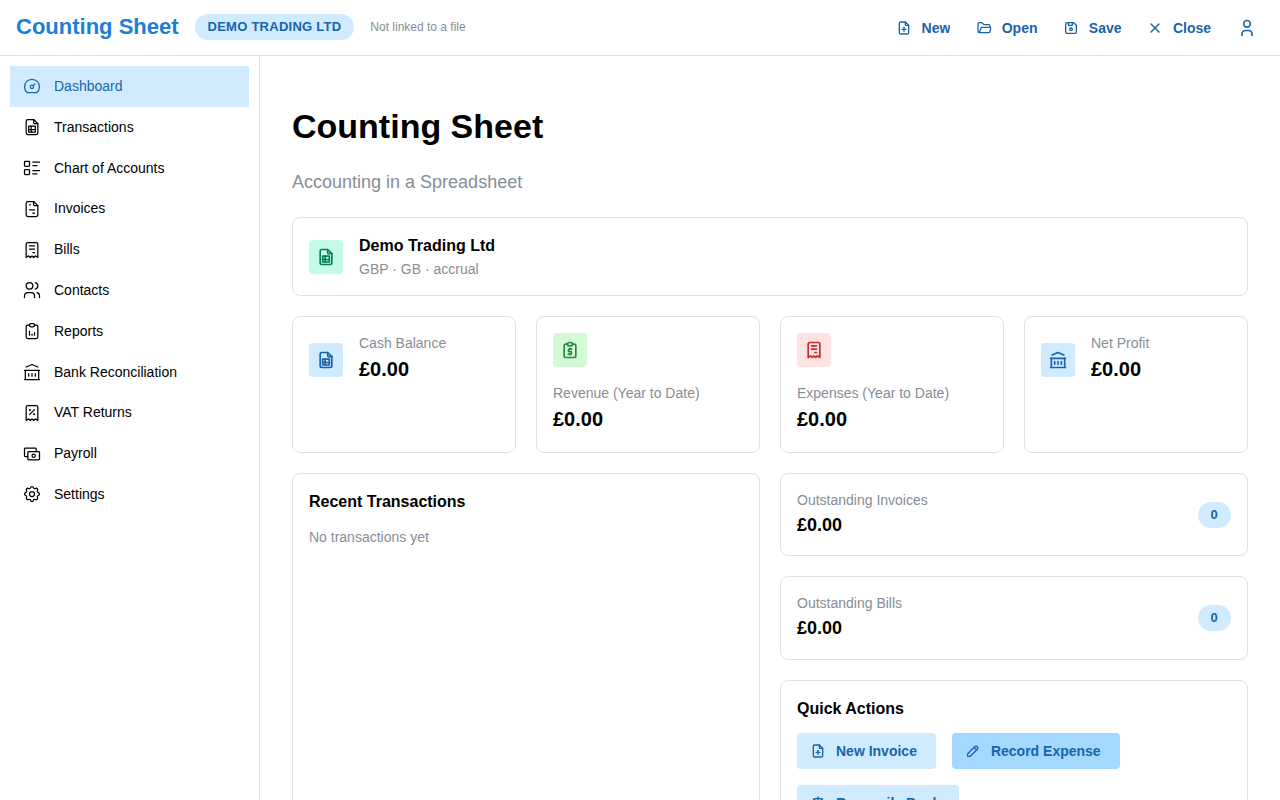
Counting Sheet does not solve this by promising to be more reliable than any other vendor; it solves it by changing where the record lives. The books are a real, multi-sheet .xlsx workbook, and that workbook is stored in your own OneDrive, Google Drive or Dropbox from day one, not copied there occasionally as a backup. If Counting Sheet disappeared tomorrow, the file with your complete chart of accounts, every journal entry, and every report you have run would still be sitting in your own cloud storage, in a format every accountant, bookkeeper and finance tool already knows how to open.
There is no export step to run, because there was never a separate copy to export from. The workbook the app was reading from and writing to is the same workbook you already had. You would lose the app's interface, the validation that keeps entries balanced, and the automatic report generation, but you would not lose a single transaction, and you would not be waiting on anyone's support queue to get your own records back.
What to actually check, whatever software you use
The honest version of this advice applies beyond Counting Sheet: ask any accounting vendor, today, while everything is working, exactly what a full export contains and in what format, and try it once so you know what you would actually be left with. A vendor that stores your books in a format you can open yourself, continuously, rather than only on request, removes the question rather than answering it.
Frequently asked questions
Is this a criticism of specific accounting platforms like Xero or QuickBooks?
No. The lock-in risk described here is structural to any SaaS model that stores your books in a database only the vendor operates, not a claim about how well any particular vendor is run.
What would I actually have if Counting Sheet shut down tomorrow?
The complete .xlsx workbook already sitting in your own OneDrive, Google Drive or Dropbox, including your chart of accounts and every journal entry, openable immediately in Excel, Google Sheets or LibreOffice.
Should I test my current software's export before I need it?
Yes. Running a full export now, while the vendor is healthy and support is responsive, tells you exactly what you would and would not get if you ever needed to leave.